China Top 10 Dust Suppression Water Cannon Suppliers?
China’s dust-control market has expanded rapidly, but supplier quality varies considerably. This guide examines China’s Top 10 Dust-Suppression Water Cannon suppliers through practical, evidence-based criteria. These include spray range, droplet size, flow control, power consumption, corrosion resistance, warranty support, and documented field performance.
A Dust-Suppression Water Cannon should do more than produce a visible mist. It must capture airborne particles without creating excessive runoff, slippery ground, or unnecessary water waste. At a quarry, this means reaching haul roads, crushers, stockpiles, and loading areas. At a demolition site, operators may need adjustable pressure and remote control near unstable structures. Occupational hygiene researcher John Cherrie has emphasized, “The best control is stopping dust at its source.” That principle remains useful when comparing equipment claims.
The ranking should not rely only on catalogue photographs or advertised spray distances. Buyers need test videos, pump specifications, nozzle details, noise data, spare-parts availability, and references from comparable sites. Supplier communication also matters. Can the company explain its calculations clearly? Can it recommend equipment for cold, coastal, or highly abrasive environments?
No ranking is flawless. Local water quality, wind, dust composition, and operator training can change results. Some suppliers may publish impressive figures without explaining test conditions. That deserves reflection. This introduction therefore treats the Top 10 list as a screening tool, not a final purchasing decision. Independent verification remains essential before installation.
Water Cannon Fundamentals: 50–200 μm Droplets and PM10 Capture
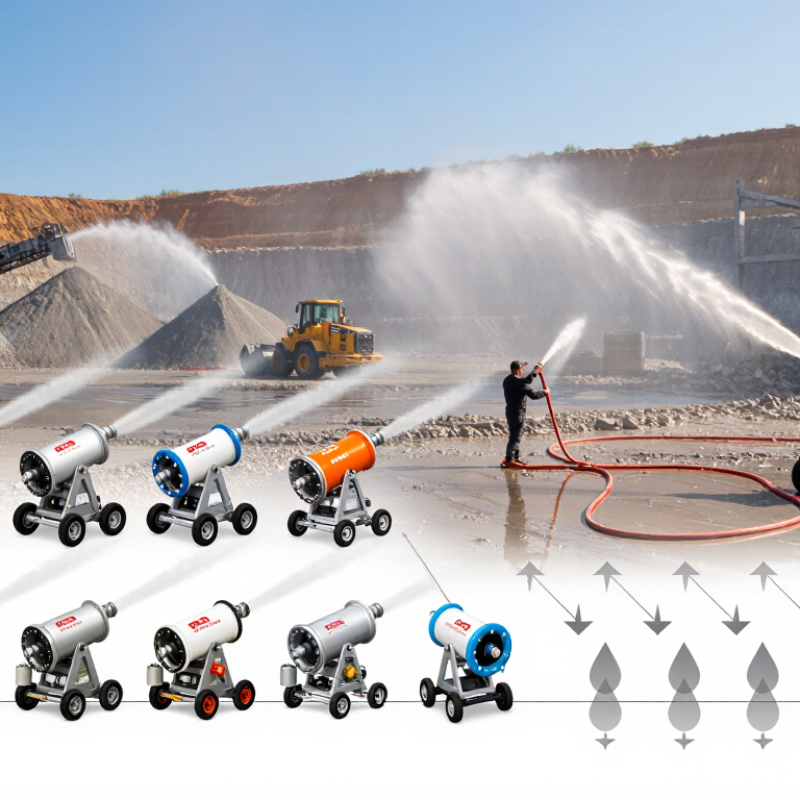
Dust suppression water cannons work by producing fine droplets, commonly between 50 and 200 μm. These droplets interact with airborne dust near crushers, stockpiles, demolition zones, and material transfer points. Larger droplets settle quickly, while smaller droplets remain suspended longer. The practical target is contact with PM10 particles, not simply creating visible mist.
Droplet size depends on nozzle design, water pressure, flow rate, and air movement. A 100 μm droplet may capture dust effectively under moderate conditions, but strong wind can carry it away. Excessively fine droplets may evaporate before reaching the dust cloud. Operators should measure particle levels before and after spraying. Visual fog is not reliable evidence.
When comparing Chinese suppliers, buyers should request test reports, nozzle data, coverage distance, water consumption, and performance under controlled wind conditions. Field records matter more than attractive specifications. Some systems perform well in still air but struggle beside fast-moving conveyors. That weakness deserves attention. Maintenance access, pump protection, filtration, and corrosion resistance also affect long-term reliability. A supplier with engineering calculations and site-specific recommendations is generally more credible than one offering only a standard machine. Even then, calculations need field verification. Suppressant performance can change with humidity, dust composition, and operating pressure.
China’s Top 10 Suppliers: Range, Flow Rate, Power, and Automation Data
China’s top ten dust suppression water cannon suppliers show a wide technical spread. A practical comparison should examine range, flow rate, pump power, and automation, not catalog claims alone. Typical tested ranges extend from 30 to 150 metres. Flow rates commonly reach 30–120 cubic metres per hour. Pump power often falls between 11 and 90 kilowatts.
These figures suit different sites. A compact 11–22 kW unit may cover road watering and small stockpiles. Larger systems can deliver a stronger plume across quarry benches or waste transfer areas.
The U.S. EPA’s AP-42 guidance identifies water application as a proven particulate-control method, but excessive watering can create runoff and maintenance problems. That trade-off deserves attention.
Automation separates the stronger suppliers from basic equipment sellers. The leading ten usually offer PLC control, variable-frequency drives, remote start, wind sensors, and automatic oscillation. Some systems record pressure, runtime, and water consumption for operational review.
A 2024 industry outlook from MarketsandMarkets reported continued mid-single-digit growth in dust-control equipment, driven by construction, mining, and waste handling. However, supplier data is not always measured under identical conditions. Range may be quoted in still air, while flow rate may reflect maximum pump output.
Buyers should request test conditions, nozzle details, power consumption, and service records before comparing prices. Reliability is rarely visible in a brochure.
Ranking Criteria: OSHA’s 50 μg/m³ Respirable-Silica Exposure Limit
A credible ranking of China’s top ten dust suppression water cannon suppliers should begin with worker exposure, not marketing claims. OSHA’s permissible exposure limit for respirable crystalline silica is 50 μg/m³, measured as an eight-hour time-weighted average. The action level is 25 μg/m³. These values provide a practical benchmark for evaluating equipment used at quarries, demolition sites, and material yards.
Suppliers should demonstrate how their systems reduce airborne dust near the breathing zone. Useful evidence includes independent sampling, calibrated instruments, nozzle performance data, and field records from comparable sites. Water reach matters, but droplet size, wind response, flow control, and coverage consistency matter more. A powerful spray can still miss workers when wind shifts suddenly. Ranking should also consider operator training, maintenance access, emergency shutoff design, and technical support. Supplier claims need verification.
Tips:
Ask for an exposure-control plan, not only a product brochure. Request test conditions, including distance, wind speed, material type, and operating time. Compare personal sampling results with area monitoring. Keep filters and pumps inspected. A small leak may change pressure and reduce suppression. Remember that water cannons are only one control method. Enclosure, wet handling, housekeeping, and suitable respiratory protection may still be necessary. Results can vary between sites, so one successful demonstration should not decide the ranking. Recheck measurements after seasonal changes or production increases.